

Though many jurisdictions have electrical inspectors that enforce the provisions of NFPA 70, National Electrical Code (NEC), there are provisions and requirements that overlap with the duties of the fire inspector. Some of these areas or occupancies include high hazard industrial facilities, paint rooms and spray booths, hazardous materials storage, and fuel handling processes and operations. These areas require that the fire inspector properly classifies the hazardous location in order to ensure proper installation of electrical wiring and components.
NFPA 70, Article 500 defines these hazardous classifications as follows, “Locations shall be classified depending on the properties of the flammable gas, flammable liquid–produced vapor, combustible liquid–produced vapors, combustible dusts, or fibers/flyings that could be present, and the likelihood that a flammable or combustible concentration or quantity is present. Each room, section, or area shall be considered individually in determining its classification.” These are divided into classes and divisions.
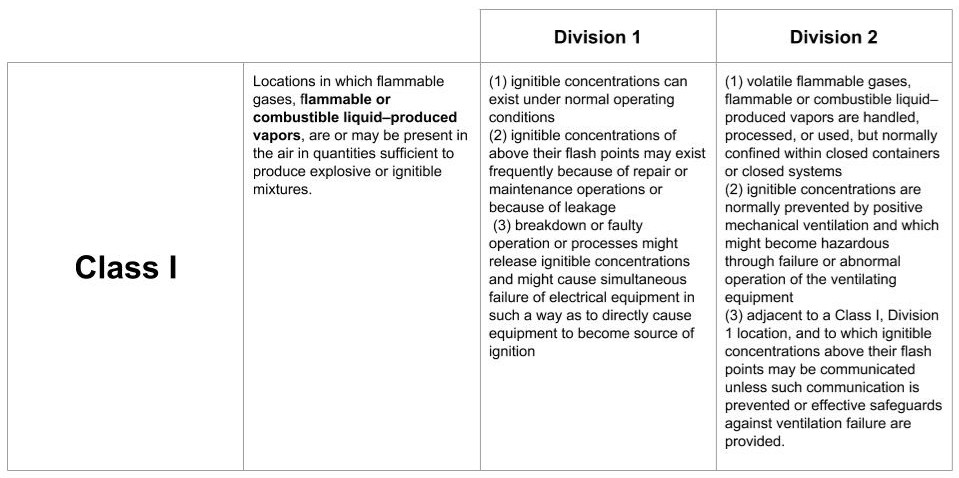
Class I - locations in which flammable gases, or flammable or combustible liquid-produced vapors are or may be present in the air in quantities sufficient to produce explosive or ignitable mixtures.
Class II - locations that are hazardous because of the presence of combustible dust.
Class III - locations that are hazardous because of the presence of easily ignited fibers, or where combustible flyings are handled, manufactured, or used.
The charts below show the Class and Divisions categories.
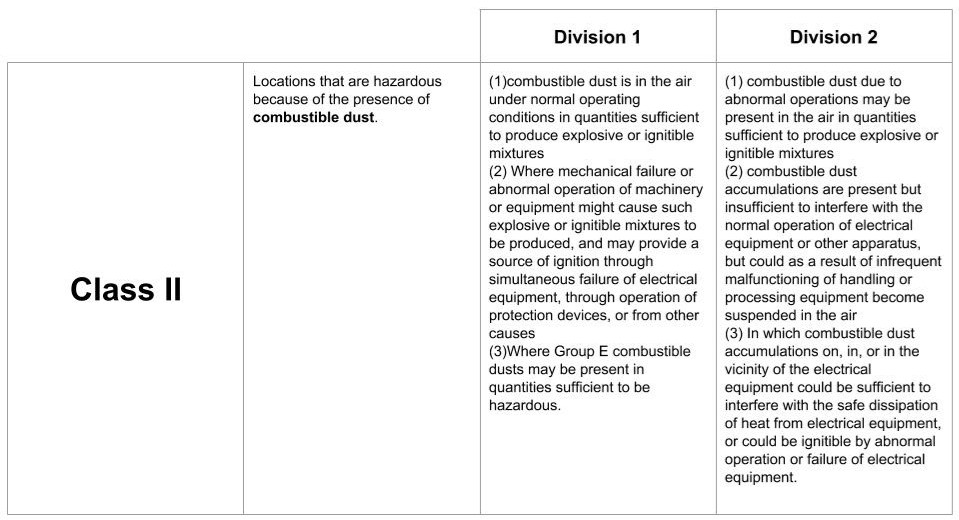
*Group E. Atmospheres containing combustible metal dusts, including aluminum, magnesium, and their commercial alloys, or other combustible dusts whose particle size, abrasiveness, and conductivity present similar hazards in the use of electrical equipment.
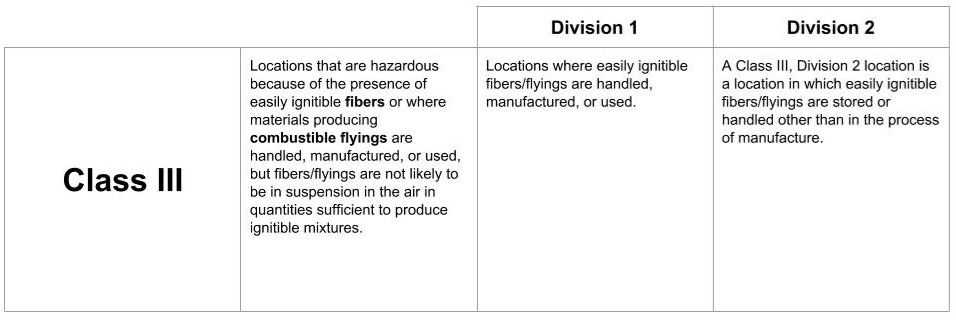
In some instances a “zone” designation may be used as an alternative to the division classification system shown here. These zones will either be Zone 0, Zone 1, Zone 2, or Zone 20, Zone 21, Zone 22. These are defined in NFPA 70, Article 505 and Article 506.
Article 505 defines Class 1, Zone 0, Zone 1, and Zone 2 as “locations where fire or explosion hazards may exist due to flammable gases, vapors, or liquids.” Article 506 defines Zone 20, Zone 21, and Zone 22 as “locations where fire and explosion hazards may exist due to combustible dusts or ignitable fibers/flyings.”
As a tool for the field inspector or plans examiner we have created a single page reference that provides quick access to the classification and division definitions.

