Pages

Showing posts with label uam. Show all posts

Vertiport Design for Fire Protection Professionals [a Review of the FAA Engineering Brief]


A few weeks ago the FAA released a draft version of its
Vertiport Design Engineering Brief. I have compiled the most important information that would be applicable to fire protection professionals who may be reviewing these plans, working through a concept of operations, or ultimately required to respond to emergencies.

This document has been created to provide facility design guidance  for VTOL aircraft powered by “electric motors and utilizing distributed electric propulsion in contrast to propulsion systems built solely around an internal combustion engine.” This guidance applies to modification of existing facilities and construction of new facilities. This guide is required to be followed by any vertiport projects that receive federal funding and by federally obligated airports. These facilities will also be required to comply with 14 CFR Part 135, Operating Requirements: Commuter and On Demand Operations and Rules Governing Persons On Board Such Aircraft.

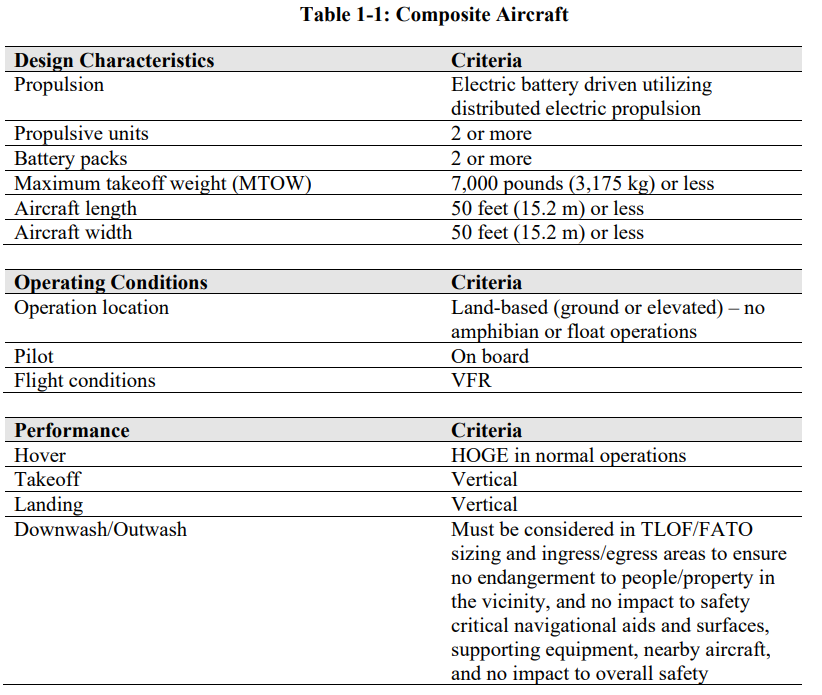
This design guide is based on pilot-on-board, visual flight rule operations, and aircraft characteristics as modeled in the below chart. The chart below was created from a composite of nine different eVTOL aircraft currently being developed. 


Terminology and Definitions


  • Composite Aircraft: the composite aircraft represents an VTOL aircraft that integrates the performance and design characteristics of nine VTOL aircraft currently in development. This composite aircraft is used to specify the performance and design characteristics for the purposes of vertiport design in this engineering brief.

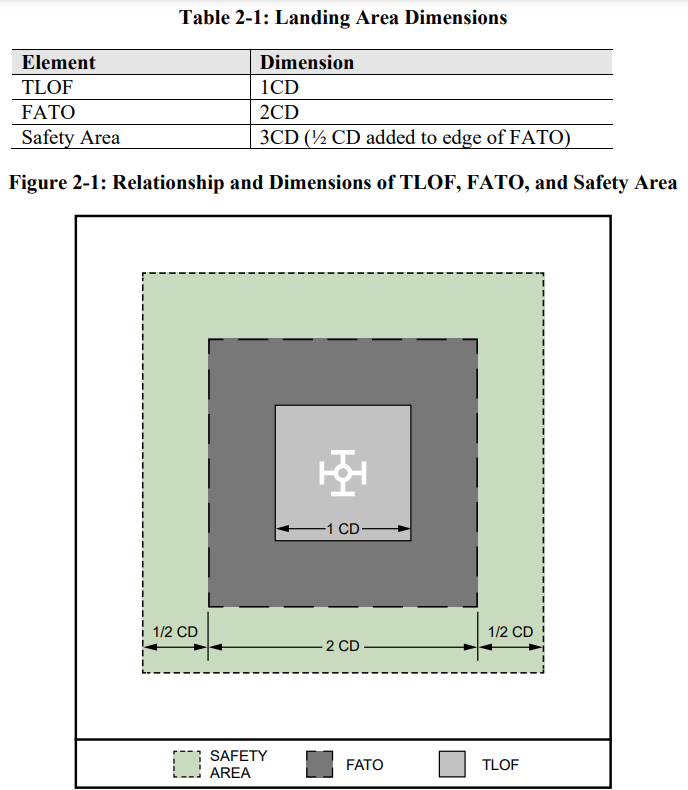
  • Controlling dimension (CD): The CD is the longest distance between the two outermost opposite points on the design VTOL aircraft (e.g., wingtip-to-wingtip, rotor tip-to-rotor tip, rotor tip-to-wing tip, fuselage-to-rotor tip), measured on a level horizontal plane that includes all adjustable components extended to their maximum outboard deflection.

  • Design VTOL aircraft: The design VTOL aircraft is the largest electric, hydrogen, or hybrid VTOL aircraft that is expected to operate at a vertiport. This design aircraft is used to determine the size of the TLOF, FATO and safety area. Note that the design VTOL aircraft is different from the composite aircraft used to define the performance and design criteria in this engineering brief.


Vertiport Dimensions and Markings


Any vertiport that is being built on a federally obligated airport must submit an Airport Laoyout Plan (ALP). Current heliport facilities that are being converted to vertiports will be required to submit a Form 7480-1 for re-designation as a vertiport.  Additionally, any State of local regulations must be followed. These can be found at, https://www.faa.gov/airports/resources/state_aviation/.


The VTOL landing area is required to be based on the controlling dimension (CD) of the design aircraft that will be using the facility. Those design criteria are depicted below:


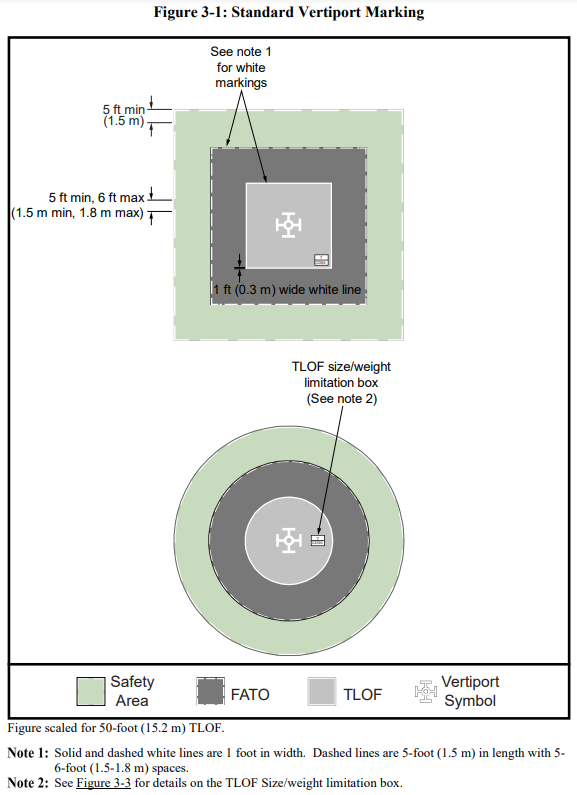
The vertiport landing and safety areas are required to be marked as shown in the diagram below:


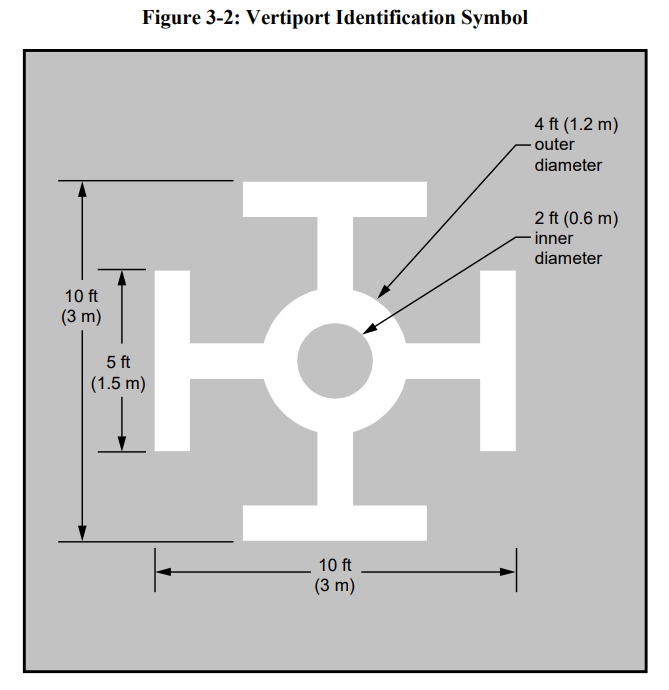
This brief also establishes and defines the an official vertiport identification marking:


Charging and Infrastructure


This engineering brief acknowledges the hazards and challenges of eVTOL charging and infrastructure. “Current charging standards for light duty vehicle charging (up to 350kw) align with multiple light electric aircraft currently applying for certification. However, higher capacity batteries and novel systems for meeting operation characteristics may require alternative chagrin methods including mobile charging systems, fixed battery storage, cable and/or on-board battery cooling, or other concepts.”  The guide then refers the user to a collection of standards that should be reviewed and applied. 


Firefighting Considerations


A brief section on firefighting acknowledges that there is no clear guidance on extinguishing fires related to these VTOL aircraft. A study is cited that states water is more effective for cooling, preventing thermal runaway, and containing the fire than was gaseous or dry powder agents. New technology on the horizon may prove to be even more effective than what is currently available. The hazards that responders should be prepared for and have an understanding of, include:

  • Lithium battery fires

  • Electrical fires

  • Toxic gas emissions

  • High voltage electrical arcing


Important Dates


The Engineering Brief and all related information can be accessed at the website here, https://www.faa.gov/airports/engineering/engineering_briefs/drafts/.


Fire Protection for UAM and eVTOL

 This week I will be in Bonita Springs, Florida attending the FSSA 40th Annual Forum. I will be giving a presentation on “Fire Protection for Emerging Aviation Technologies”. This presentation will define urban air mobility, outline where the technology is, clarify what the current state of fire protection for UAM and eVTOL is, and identify what fire protection innovations are needed, and how to be involved in setting the future fire protection direction for this technology. 


As a primer to this presentation and to fire protection for UAM, below is a collection of articles and resources related to fire protection for UAM and eVTOL.


This new aircraft technology will necessitate a change in how they are protected within their hangars. These articles outline the changes that will allow this within the 2022 edition of NFPA 409.


The key to getting ahead in this industry is to get involved and stay involved. Here are three organizations that are actively engaged in the future of fire protection for UAM.


Want to learn more about this technology and fire protection? Connect with me by using one of the options below.


Want to change the world? You might have to change a code or standard first. Learn how with this free guide, Affecting Change Through Codes and Standards.


Have questions, issues, or concerns? Schedule a free consultation with me.


Contact me through my website at, www.aaronj.org.


You can subscribe to get this update in your email by clicking here.


Code Update [January 2022]


Keeping up with code change proposals and the code cycle can be an overwhelming task. I want to make it easier for you. I am involved in the codes and standards for three specific industries: security, aviation, and technology.  At the beginning of every month I will send out an update on what's happening, and what's next.


You can subscribe to get this update in your email by clicking here.


Also, you can track the code changes, proposals, and my commentary by accessing these live spreadsheets.


Security Codes and Standards


Public Input Due:

  • January 5, 2022: NFPA 1321, Fire Investigation Units

Personal commentary: Anyone involved in fire investigations should carefully review this document. It is set up as a standard that pertains to private and public entities (departments, companies, sole practitioners) that conduct fire investigations. There are a lot of sections that deal with business practices, which seems to be an overreach of NFPA, and potentially burdensome on jurisdictions tasked with enforcement of this standard. Additionally, this standard covers many items that NFPA 921 and 1033 already direct the user to.


Public Comment Due:


Second Draft Meeting:

  • January 11, 18, 20-21, 24-26: NFPA 1660 (Emergency Management/Business Continuity)


Aviation Codes and Standards


Public Input Due:

  • January 5, 2022: NFPA 418 (Helicopter Facilities)


Personal commentary: This should be of particular interest to those in the UAM and eVTOL space. This will become the guiding document on fire protection for UAM and eVTOL infrastructure. It is important that the industry uses their voice. This is the tool to use to do that.


Pre-First Draft Meeting:


Technology Codes and Standards


First draft report posting:

  • March 22, 2022: NFPA 915, Remote Inspections
  • October 26, 2022: NFPA 2400, Unmanned Aircraft Systems


Next edition TBD:


Want to change the world? You might have to change a code or standard first. Learn how with this free guide, Affecting Change Through Codes and Standards.


Have questions, issues, or concerns? Schedule a free consultation with me.


Contact me through my website at, www.aaronj.org.


Aviation Fire Prevention - is it time for an advanced credentialing program?


In the fire service, we have advanced certifications and credentialing for almost every niche within the industry. There is the beginning required certifications of, EMT and firefighter. Progressing on to advanced level training of paramedic or officer level certifications.  Then there is specialty training on truck operations, technical rescue, hazardous materials, and ARFF. Beyond these, at the highest levels there is credentialing through organizations such as the Center for Public Safety Excellence.  The world of aviation firefighting is no different. In this niche industry we have the basic ARFF certification, we have ARFF specific officer certifications, and specialty training programs. We have credentialing as an A.M.F. through the ARFFWG and AAAE.  The ARFF training and educational path is further clarified through the ARFF Professional Development Framework Manual.  

When it comes to the area of fire prevention, especially in aviation, there is no established path or further specialized training. The same requirements for a fire inspector for the municipal structural department is all that is required for the airport and ARFF department. However, the environment, challenges, hazards, systems, processes, and code applications can be very different. Fire prevention in the ARFF environment is a specialized field and should require an advanced (or additional) level of training to ensure basic competence and understanding of the hazards and code applications that will apply. 

I have created a draft program outline. The program is called the Aviation Fire Prevention Credentialing Program. What follows is a brief outline of the program. The complete program and proposed curriculum can be downloaded here.

The program is divided into two credentials -- Aviation Fire Inspector (AFI), and the Aviation Fire Prevention Officer (AFPO).  The point-of-entry for this program is certification (State/IFSAC/ICC/ProBoard) as a Fire Inspector I, Fire Inspector II, and three years of experience in fire prevention or ARFF.

The first level of credentialing is the Aviation Fire Inspector (AFI)

AFI credential program prerequisites:

  • Certified as Fire Inspector I/II (State/IFSAC/ICC/ProBoard)
  • Three years of experience in fire prevention or ARFF
The process for becoming a credentialed AFI is as follows:

  • Submit application
  • Application is reviewed and approved
  • Candidate must register for and attend the 24 hour ‘Aviation Fire Inspector Course’ 
  • Pass the class final exam with at least an 75%
  • Credential awarded
The next level of credentialing is the Aviation Fire Prevention Officer (AFPO) credential. This credential is designed for the highest ranking fire prevention official, with program management and leadership responsibilities.

AFPO credential program prerequisites:

  • Successful completion of AFI credential.
  • Minimum of Fire Officer 1 certification (Fire Officer 2 recommended)
  • Minimum of 5 years experience in ARFF and/or fire prevention.
The process for becoming a credentialed AFPO is as follows:

  • Submit application
  • Application is reviewed and approved
  • Completion of 24 hour ‘Aviation Fire Prevention Officer Course’ 
  • Pass the class final exam with at least an 75%
  • Completion and presentation of an applied research paper (management, case study, proposal, project)
  • Credential awarded
Download the full program and curriculum here.

What are your thoughts? Is it time for a credentialing program? Do you see a need for this type of training, credentialing process? I am looking for your feedback. Please comment below, or contact me directly at, thecodecoach@gmail.com.


www.AaronJ.org

Schedule a FREE consultation