Pages

Showing posts with label ARFF. Show all posts

Vertiport Design for Fire Protection Professionals [a Review of the FAA Engineering Brief]


A few weeks ago the FAA released a draft version of its
Vertiport Design Engineering Brief. I have compiled the most important information that would be applicable to fire protection professionals who may be reviewing these plans, working through a concept of operations, or ultimately required to respond to emergencies.

This document has been created to provide facility design guidance  for VTOL aircraft powered by “electric motors and utilizing distributed electric propulsion in contrast to propulsion systems built solely around an internal combustion engine.” This guidance applies to modification of existing facilities and construction of new facilities. This guide is required to be followed by any vertiport projects that receive federal funding and by federally obligated airports. These facilities will also be required to comply with 14 CFR Part 135, Operating Requirements: Commuter and On Demand Operations and Rules Governing Persons On Board Such Aircraft.

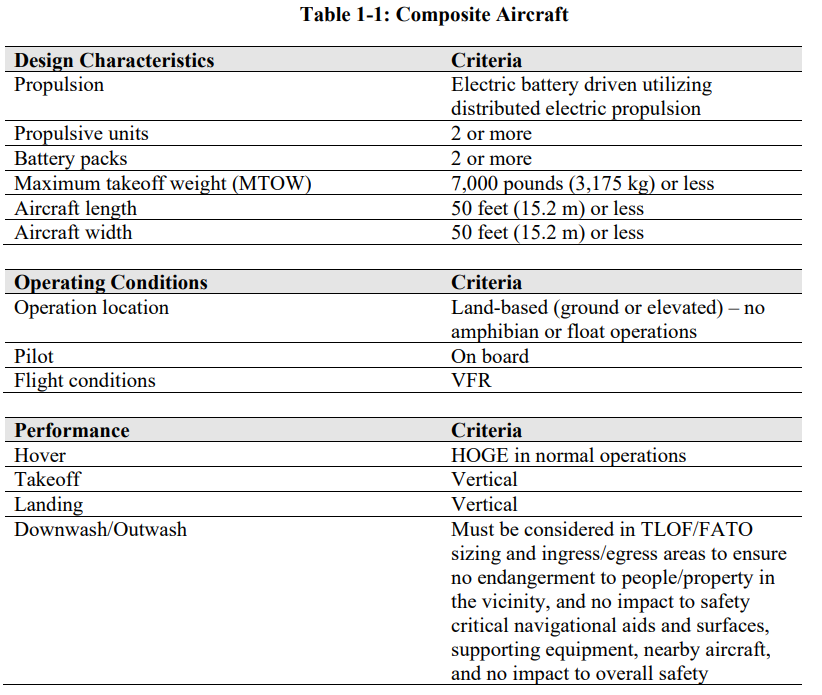
This design guide is based on pilot-on-board, visual flight rule operations, and aircraft characteristics as modeled in the below chart. The chart below was created from a composite of nine different eVTOL aircraft currently being developed. 


Terminology and Definitions


  • Composite Aircraft: the composite aircraft represents an VTOL aircraft that integrates the performance and design characteristics of nine VTOL aircraft currently in development. This composite aircraft is used to specify the performance and design characteristics for the purposes of vertiport design in this engineering brief.

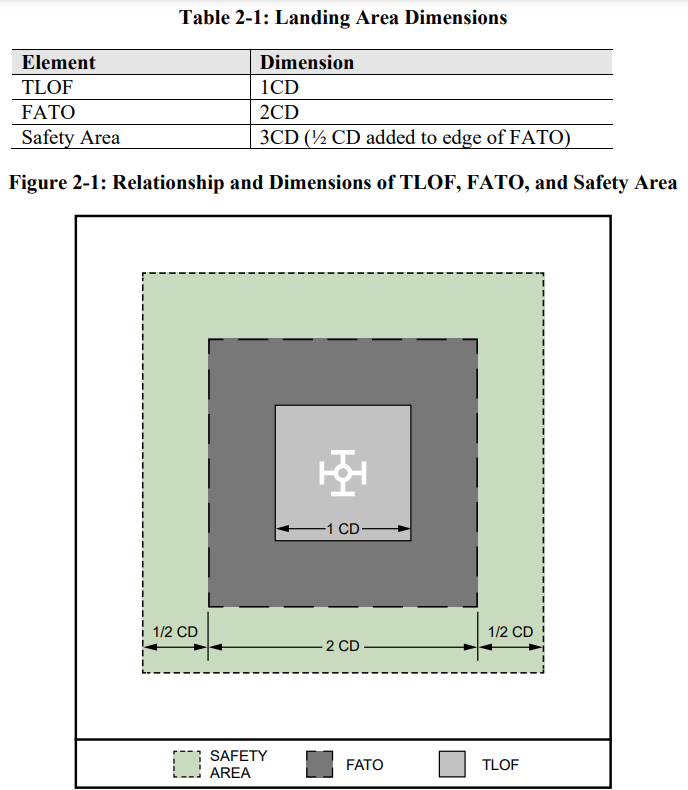
  • Controlling dimension (CD): The CD is the longest distance between the two outermost opposite points on the design VTOL aircraft (e.g., wingtip-to-wingtip, rotor tip-to-rotor tip, rotor tip-to-wing tip, fuselage-to-rotor tip), measured on a level horizontal plane that includes all adjustable components extended to their maximum outboard deflection.

  • Design VTOL aircraft: The design VTOL aircraft is the largest electric, hydrogen, or hybrid VTOL aircraft that is expected to operate at a vertiport. This design aircraft is used to determine the size of the TLOF, FATO and safety area. Note that the design VTOL aircraft is different from the composite aircraft used to define the performance and design criteria in this engineering brief.


Vertiport Dimensions and Markings


Any vertiport that is being built on a federally obligated airport must submit an Airport Laoyout Plan (ALP). Current heliport facilities that are being converted to vertiports will be required to submit a Form 7480-1 for re-designation as a vertiport.  Additionally, any State of local regulations must be followed. These can be found at, https://www.faa.gov/airports/resources/state_aviation/.


The VTOL landing area is required to be based on the controlling dimension (CD) of the design aircraft that will be using the facility. Those design criteria are depicted below:


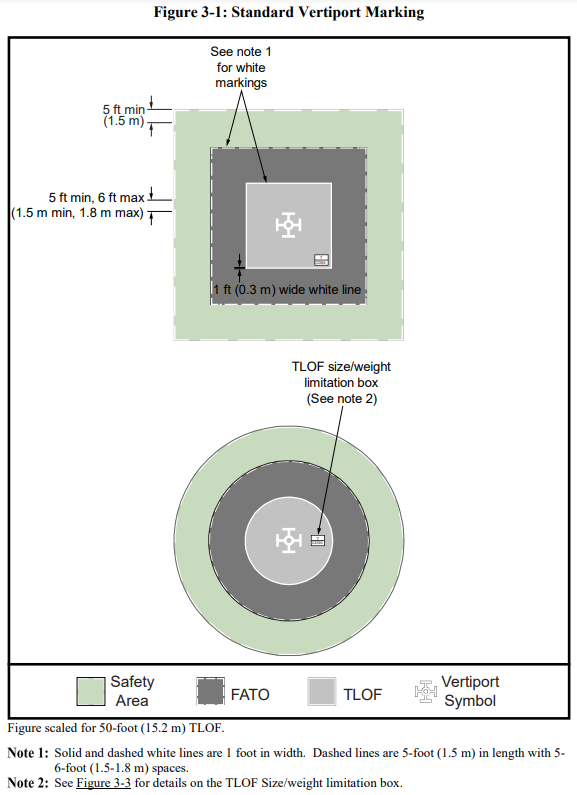
The vertiport landing and safety areas are required to be marked as shown in the diagram below:


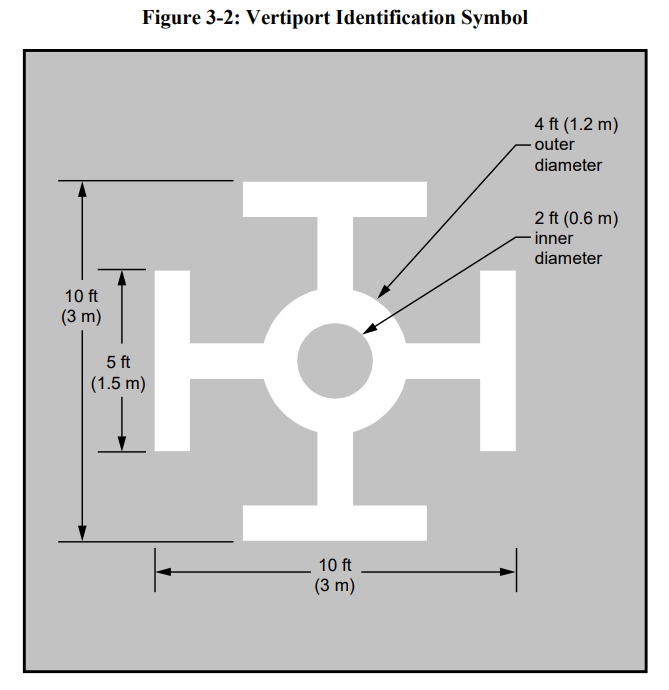
This brief also establishes and defines the an official vertiport identification marking:


Charging and Infrastructure


This engineering brief acknowledges the hazards and challenges of eVTOL charging and infrastructure. “Current charging standards for light duty vehicle charging (up to 350kw) align with multiple light electric aircraft currently applying for certification. However, higher capacity batteries and novel systems for meeting operation characteristics may require alternative chagrin methods including mobile charging systems, fixed battery storage, cable and/or on-board battery cooling, or other concepts.”  The guide then refers the user to a collection of standards that should be reviewed and applied. 


Firefighting Considerations


A brief section on firefighting acknowledges that there is no clear guidance on extinguishing fires related to these VTOL aircraft. A study is cited that states water is more effective for cooling, preventing thermal runaway, and containing the fire than was gaseous or dry powder agents. New technology on the horizon may prove to be even more effective than what is currently available. The hazards that responders should be prepared for and have an understanding of, include:

  • Lithium battery fires

  • Electrical fires

  • Toxic gas emissions

  • High voltage electrical arcing


Important Dates


The Engineering Brief and all related information can be accessed at the website here, https://www.faa.gov/airports/engineering/engineering_briefs/drafts/.

Fire Protection for UAM and eVTOL

 This week I will be in Bonita Springs, Florida attending the FSSA 40th Annual Forum. I will be giving a presentation on “Fire Protection for Emerging Aviation Technologies”. This presentation will define urban air mobility, outline where the technology is, clarify what the current state of fire protection for UAM and eVTOL is, and identify what fire protection innovations are needed, and how to be involved in setting the future fire protection direction for this technology. 


As a primer to this presentation and to fire protection for UAM, below is a collection of articles and resources related to fire protection for UAM and eVTOL.


This new aircraft technology will necessitate a change in how they are protected within their hangars. These articles outline the changes that will allow this within the 2022 edition of NFPA 409.


The key to getting ahead in this industry is to get involved and stay involved. Here are three organizations that are actively engaged in the future of fire protection for UAM.


Want to learn more about this technology and fire protection? Connect with me by using one of the options below.


Want to change the world? You might have to change a code or standard first. Learn how with this free guide, Affecting Change Through Codes and Standards.


Have questions, issues, or concerns? Schedule a free consultation with me.


Contact me through my website at, www.aaronj.org.


You can subscribe to get this update in your email by clicking here.


Leadership Resources for ARFF Professionals [Being Chief]


Being Chief: Leadership Principles for the ARFF Professional, is the first book of its kind, dedicated solely to leadership in the aircraft rescue and firefighting field. More than thirty ARFF chiefs and leaders were interviewed for this book. Read more about the book in this post and this post.

One of the questions asked was what is a book or resource that they would recommend for continued leadership development. There were a lot of similar answers. The books below were the most frequently cited by these ARFF leaders. These are their recommendations for continued education and professional development.


Holy Bible - The CSB Heroes Bibles feature the highly reliable, highly readable text of the Christian Standard Bible (CSB), which stays as literal as possible to the Bible’s original meaning without sacrificing clarity. The CSB’s optimal blend of accuracy and readability makes Scripture more moving, more memorable, and more motivating to read it today and share it always.


First In, Last Out, John Salka - What does it take to lead people into a burning building? How do the leaders of the New York City Fire Department develop so much loyalty, trust, and grace under pressure that their subordinates will risk their very lives for them? As a high-ranking officer of the FDNY, John Salka is an expert at both practicing and teaching high-stakes leadership. He explains the department’s unique strategies and how they can be adopted by leaders in any field


It’s Your Ship, Michael Abrashoff- When Captain Abrashoff took over as commander of USS Benfold, it was like a business that had all the latest technology but only some of the productivity. Knowing that responsibility for improving performance rested with him, he realized he had to improve his own leadership skills before he could improve his ship. Within months, he created a crew of confident and inspired problem-solvers eager to take the initiative and responsibility for their actions. The slogan on board became "It's your ship," and Benfold was soon recognized far and wide as a model of naval efficiency. Abrashoff shares his secrets of successful management


Pride and Ownership, Rick Lasky - Chief Rick Lasky gives an upfront and honest criticism about the need to reignite the love of the job on every level, from chiefs and on down. Learn what you can do to drive your members to take pride in their job and assume ownership. 


Essentials of Fire Department Customer Service, Alan Brunacini - This text explains the application of common-sense customer service concepts to the fire service. Written in a humorous conversational style, Chief Alan Brunacini of the Phoenix Fire Department provides the reader with an enjoyable reading experience and vital information on how we can better serve our customers.


From Buddy to Boss, Chase Sargent - Whether you're a new officer or in need of a mentor, From Buddy to Boss: Effective Fire Service Leadership, is a must-have management book you'll turn to over and over again. Fire service veteran Chase Sargent has taken his popular course and written a no-holds-barred leadership book for the fire service in a conversational and easy-to-read style. He tells you how to accept and survive politics, deal with the fringe employees, and keep your cool -- tricks of the trade that usually take years to acquire


The Fifth Discipline, Peter Senge - Senge describes how companies can rid themselves of the learning blocks that threaten their productivity and success by adopting the strategies of learning organizations, in which new and expansive patterns of thinking are nurtured, collective aspiration is set free, and people are continually learning how to create the results they truly desire.


Extreme Ownership, Jocko Willink - Detailing the mind-set and principles that enable SEAL units to accomplish the most difficult missions in combat, Extreme Ownership shows how to apply them to any team, family or organization. Each chapter focuses on a specific topic such as Cover and Move, Decentralized Command, and Leading Up the Chain, explaining what they are, why they are important, and how to implement them in any leadership environment.


The Dichotomy of Leadership, Jocko Willink and Leif Babin - Jocko and Leif dive even deeper into the uncharted and complex waters of a concept first introduced in Extreme Ownership: finding balance between the opposing forces that pull every leader in different directions. Here, Willink and Babin get granular in the nuances that every successful leader must navigate. Mastering the Dichotomy of Leadership requires understanding when to lead and when to follow; when to aggressively maneuver and when to pause and let things develop; when to detach and let the team run and when to dive into the details and micromanage.


Qualities for ARFF Leadership Success [Being Chief]


Being Chief: Leadership Principles for the ARFF Professional, is the first book of its kind, dedicated solely to leadership in the aircraft rescue and firefighting field. More than thirty ARFF chiefs and leaders were interviewed for this book. Through the process of compiling the information from these discussions, a pattern for success emerged. Similar topics were discussed, and certain traits rose to the top. These came through these four questions:
  1. What is your advice for the newly promoted chief officer?
  2. What actions, behaviors, or thought patterns lead to leadership failure?
  3. What is the top trait or characteristic that you believe every chief officer must possess?
  4. What have been the key factors to your success and why?


What is your advice for the newly promoted chief officer?

  1. Listen, to those above and below.
  2. Learn, from others, from past successes and mistakes, commit to continual education.
  3. Be with your people, they are the priority.
  4. Remember where you came from, and how you got here.
  5. Be consistent, always show up.

What actions, behaviors, or thought patterns lead to leadership failure?

  1. Lack of respect for people.

    1. Failure to recognize and adjust to different personality types.

    2. Poor treatment, demeaning, unfair, unequitable.

    3. Not ‘learning’ your people, or knowing who they are.

    4. Failure to provide discipline and clear direction.

    5. Not trusting your people.

  2. Lack of integrity.

    1. Not being true to your word.

    2. Being inconsistent.

    3. Non-committed to department, people, direction, or vision.

    4. Self-serving.

  3. Poor communication.

    1. Not listening.

    2. Unable to commit to decisions, lack of clarity in decision making.

    3. Unclear vision and prioritizing personal agendas.


What is the top trait or characteristic that you believe every chief officer must possess?

  1. Trust

  2. Honesty

  3. Integrity

  4. Humility (approachable, listen, learn)


What have been the key factors to your success and why?

  1. Knowing the job.

    1. Commit to continual learning.

    2. Stay relevant by listening to others.

    3. Network with other chiefs, organizations, and departments.

  2. Consistency.

    1. Persevere.

    2. Show up everyday at 100%.

    3. Build experience.

  3. Faith.

  4. Family.

    1. Support of...

    2. Succeed for…


Being Chief takes a deep dive into each of these areas and topics, and lets you hear from the leaders themselves, in their own words through their own experiences.


Being Chief: Leadership Principles for the ARFF Professional


Today, I announce the launch of my new book, Being Chief: Leadership Principles for the ARFF Professional. This is the first, and only, book dedicated to leadership for the aircraft rescue firefighter.


Why did I write this book?


As the leaders and the experienced in our profession age out, we are forever losing their wisdom and shared knowledge. Private industry realizes this and tries to capture that knowledge through, what is referred to as, “knowledge management”.


Knowledge management can be simply defined as, “the process of capturing, distributing, and effectively using knowledge.”  Knowledge management is taking advantage of what is known to maximize an organization’s value, or a department’s value to the community. Of knowledge, there are two types, explicit and implicit. Explicit knowledge is data, facts, and captured documentation. Implicit is the knowledge that exists in the heads of people and is only acquired over time through education and experience. This implicit knowledge becomes codified when it is shared through discussions or documentation.


Being Chief is a best effort to jump start a formal knowledge management process in the ARFF industry. For this book, interviews, surveys, and follow-up conversations were conducted from more than thirty ARFF chiefs and leaders. 


The book is divided into three parts:

Part 1: Leadership Lessons. Common themes, advice, lessons learned from these conversations are compiled and shared in this section.

Part 2: “In their own words…”. This section includes the full interview, survey responses, and personal stories from these leaders.

Part 3: Leading On. This section identifies mentors that have gone before, the value of mentoring, and provides recommended resources for leadership development.


What can you learn from reading this book?


There are many books on fire service leadership, and many more on leadership in general, however, this is the only book that focuses on leadership within the unique niche industry of the  aircraft rescue and firefighting environment.  


Being Chief will prepare the ARFF professional for a leadership role by enabling them to:

  • Know the most valuable traits an ARFF chief or leader must possess

  • Understand the five actions an ARFF leader must apply for maximum leadership impact

  • Hear directly from the voice of experience of those who have excelled in the industry

  • Prepare for a major aircraft incident response and post-incident effects


Being Chief
is a tool for the ambitious and forward-thinking ARFF professional. This is a tool to be used for gaining the knowledge, skills, and abilities needed to achieve their leadership goals. By reading and learning from the years of experience shared here, the gap to achieving a leadership mindset can be decreased.

Aviation Fire Prevention - is it time for an advanced credentialing program?


In the fire service, we have advanced certifications and credentialing for almost every niche within the industry. There is the beginning required certifications of, EMT and firefighter. Progressing on to advanced level training of paramedic or officer level certifications.  Then there is specialty training on truck operations, technical rescue, hazardous materials, and ARFF. Beyond these, at the highest levels there is credentialing through organizations such as the Center for Public Safety Excellence.  The world of aviation firefighting is no different. In this niche industry we have the basic ARFF certification, we have ARFF specific officer certifications, and specialty training programs. We have credentialing as an A.M.F. through the ARFFWG and AAAE.  The ARFF training and educational path is further clarified through the ARFF Professional Development Framework Manual.  

When it comes to the area of fire prevention, especially in aviation, there is no established path or further specialized training. The same requirements for a fire inspector for the municipal structural department is all that is required for the airport and ARFF department. However, the environment, challenges, hazards, systems, processes, and code applications can be very different. Fire prevention in the ARFF environment is a specialized field and should require an advanced (or additional) level of training to ensure basic competence and understanding of the hazards and code applications that will apply. 

I have created a draft program outline. The program is called the Aviation Fire Prevention Credentialing Program. What follows is a brief outline of the program. The complete program and proposed curriculum can be downloaded here.

The program is divided into two credentials -- Aviation Fire Inspector (AFI), and the Aviation Fire Prevention Officer (AFPO).  The point-of-entry for this program is certification (State/IFSAC/ICC/ProBoard) as a Fire Inspector I, Fire Inspector II, and three years of experience in fire prevention or ARFF.

The first level of credentialing is the Aviation Fire Inspector (AFI)

AFI credential program prerequisites:

  • Certified as Fire Inspector I/II (State/IFSAC/ICC/ProBoard)
  • Three years of experience in fire prevention or ARFF
The process for becoming a credentialed AFI is as follows:

  • Submit application
  • Application is reviewed and approved
  • Candidate must register for and attend the 24 hour ‘Aviation Fire Inspector Course’ 
  • Pass the class final exam with at least an 75%
  • Credential awarded
The next level of credentialing is the Aviation Fire Prevention Officer (AFPO) credential. This credential is designed for the highest ranking fire prevention official, with program management and leadership responsibilities.

AFPO credential program prerequisites:

  • Successful completion of AFI credential.
  • Minimum of Fire Officer 1 certification (Fire Officer 2 recommended)
  • Minimum of 5 years experience in ARFF and/or fire prevention.
The process for becoming a credentialed AFPO is as follows:

  • Submit application
  • Application is reviewed and approved
  • Completion of 24 hour ‘Aviation Fire Prevention Officer Course’ 
  • Pass the class final exam with at least an 75%
  • Completion and presentation of an applied research paper (management, case study, proposal, project)
  • Credential awarded
Download the full program and curriculum here.

What are your thoughts? Is it time for a credentialing program? Do you see a need for this type of training, credentialing process? I am looking for your feedback. Please comment below, or contact me directly at, thecodecoach@gmail.com.


www.AaronJ.org

Schedule a FREE consultation