Pages

Showing posts with label resources. Show all posts

Online Platforms for Codes and Standards


I love books, especially code books. I love getting that new code book in the mail, I love holding it in my hand and flipping through its pages, and I love to look over and see it on my physical bookshelf. The reality of books, though, is that they are heavy, bulky, take up space, you can lose track of your notes and highlights, and you can not take your full bookshelf with you wherever you go. With online codes and standards platforms this is possible. These platforms allow the user to easily bookmark, save, and annotate important sections. These platforms provide instant access to every code and standard that the user may need. And these platforms make those code sections, and your notes, easy to share with collaborators and clients. 

The NFPA and ICC each have their own online platforms. A third option, UpCodes, brings all of these together into one place. Below is a brief review and general information on each of these platforms.


Cost: $9.99 per month


The free view of NFPA codes and standards only provides a read-only file that cannot be marked, shared, or printed. NFPA LiNK, provides the user with full access to the codes and standard. The user can quickly and easily search, bookmark, annotate, and share code sections. This NFPA LiNK interface is visually appealing (it looks like books on a shelf) and user friendly. This program provides access to all NFPA codes and standards and multiple versions of each. This platform offers a feature that none of the others offer, that is offline access. At $9.99 per month, it is the most affordable of the online platforms. 


More information: https://www.nfpa.org/NFPA-LiNK


https://codes.iccsafe.org/signup/trial

Cost: $59.50 per month (members)


The free view of ICC codes only provides a read-only file that cannot be marked, shared, or printed. ICC Digital Codes Premium, provides access to the full library of ICC codes, standards, commentary, study guides, and other documents. This subscription also provides access to the documents that are published under the ICC family of companies, such as from, IAEI, SEAOC, Wiley. Also available are standards from ASHRAE, ANSI, FEMA, RESNET, and others. This platform lets the user search and access codes and standards by state, collection, or publisher.  This is the least user friendly and visually appealing of the platforms. It is also the most expensive.


More information: https://codes.iccsafe.org/premium-features


https://up.codes/

Cost: Free to view, link, copy, print

$33.00 per month for premium features


UpCodes, overall, is the best product and investment. It provides access to codes and standards across a wide range of publishers and organizations including: NFPA, ICC, ANSI, IAPMO, ASHRAE, OSHA, and more. These can be searched by publisher or by jurisdiction. UpCodes contains only the codes and standards that have been adopted into law by a government agency and, therefore, fall under public domain use. The free version of UpCodes allows the user to view, link to, copy, and print code sections. Premium features provide for bookmarking, notes, projects that can be created, saved, and shared with collaborators, illustrative diagrams and commentary, code calculators, and robust search functions. UpCodes provides access to multiple code families and publishers, with links to references within the documents. This platform is user friendly, and easy to navigate and visually appealing. 


More information: https://up.codes/features


In conclusion…


If your work requires codes and standards use and research, you have to get on-board with these online platforms. They increase efficiency, effectiveness, and compliance accuracy. If you primarily deal in the ICC family of codes then perhaps the ICC Digital Codes Premium would be your best option. For jurisdictional code officials, consultants, architects, and those who work across jurisdictions, UpCodes may be your best option. For those who use NFPA specific documents within their industry, such as the fire departments, manufacturers, or occupancy specific functions, and NFPA LiNK subscription may be the best option. Or, perhaps, a combination of one or all of these platforms is what will serve you, the user, best!


Leadership Resources for ARFF Professionals [Being Chief]


Being Chief: Leadership Principles for the ARFF Professional, is the first book of its kind, dedicated solely to leadership in the aircraft rescue and firefighting field. More than thirty ARFF chiefs and leaders were interviewed for this book. Read more about the book in this post and this post.

One of the questions asked was what is a book or resource that they would recommend for continued leadership development. There were a lot of similar answers. The books below were the most frequently cited by these ARFF leaders. These are their recommendations for continued education and professional development.


Holy Bible - The CSB Heroes Bibles feature the highly reliable, highly readable text of the Christian Standard Bible (CSB), which stays as literal as possible to the Bible’s original meaning without sacrificing clarity. The CSB’s optimal blend of accuracy and readability makes Scripture more moving, more memorable, and more motivating to read it today and share it always.


First In, Last Out, John Salka - What does it take to lead people into a burning building? How do the leaders of the New York City Fire Department develop so much loyalty, trust, and grace under pressure that their subordinates will risk their very lives for them? As a high-ranking officer of the FDNY, John Salka is an expert at both practicing and teaching high-stakes leadership. He explains the department’s unique strategies and how they can be adopted by leaders in any field


It’s Your Ship, Michael Abrashoff- When Captain Abrashoff took over as commander of USS Benfold, it was like a business that had all the latest technology but only some of the productivity. Knowing that responsibility for improving performance rested with him, he realized he had to improve his own leadership skills before he could improve his ship. Within months, he created a crew of confident and inspired problem-solvers eager to take the initiative and responsibility for their actions. The slogan on board became "It's your ship," and Benfold was soon recognized far and wide as a model of naval efficiency. Abrashoff shares his secrets of successful management


Pride and Ownership, Rick Lasky - Chief Rick Lasky gives an upfront and honest criticism about the need to reignite the love of the job on every level, from chiefs and on down. Learn what you can do to drive your members to take pride in their job and assume ownership. 


Essentials of Fire Department Customer Service, Alan Brunacini - This text explains the application of common-sense customer service concepts to the fire service. Written in a humorous conversational style, Chief Alan Brunacini of the Phoenix Fire Department provides the reader with an enjoyable reading experience and vital information on how we can better serve our customers.


From Buddy to Boss, Chase Sargent - Whether you're a new officer or in need of a mentor, From Buddy to Boss: Effective Fire Service Leadership, is a must-have management book you'll turn to over and over again. Fire service veteran Chase Sargent has taken his popular course and written a no-holds-barred leadership book for the fire service in a conversational and easy-to-read style. He tells you how to accept and survive politics, deal with the fringe employees, and keep your cool -- tricks of the trade that usually take years to acquire


The Fifth Discipline, Peter Senge - Senge describes how companies can rid themselves of the learning blocks that threaten their productivity and success by adopting the strategies of learning organizations, in which new and expansive patterns of thinking are nurtured, collective aspiration is set free, and people are continually learning how to create the results they truly desire.


Extreme Ownership, Jocko Willink - Detailing the mind-set and principles that enable SEAL units to accomplish the most difficult missions in combat, Extreme Ownership shows how to apply them to any team, family or organization. Each chapter focuses on a specific topic such as Cover and Move, Decentralized Command, and Leading Up the Chain, explaining what they are, why they are important, and how to implement them in any leadership environment.


The Dichotomy of Leadership, Jocko Willink and Leif Babin - Jocko and Leif dive even deeper into the uncharted and complex waters of a concept first introduced in Extreme Ownership: finding balance between the opposing forces that pull every leader in different directions. Here, Willink and Babin get granular in the nuances that every successful leader must navigate. Mastering the Dichotomy of Leadership requires understanding when to lead and when to follow; when to aggressively maneuver and when to pause and let things develop; when to detach and let the team run and when to dive into the details and micromanage.


Innovating Our Industry [Seven Survival Skills]

Innovator. An innovator is defined as a person who introduces new methods, ideas, or products. these are individuals who blaze a trail into a new territory. Innovation is necessary for our survival - as a people, and as an industry.


In his book Creating Innovators: The Making of Young People Who Will Change the World, Tony Wagner provides a clear argument for the changes that are needed in our educational system (and to some extent, our parenting styles) to create innovative people. Without innovation, we will cease to develop and exist. In his previous book, Tony identified seven survival skills that people need to possess and foster in others in order for us to continue to thrive.  These skills are also what is needed within our industry of fire protection, life safety, and codes and standards development, to enable its continued growth and impact.
  1. Critical thinking and problem solving.
  2. Collaboration across networks and leading by influence.
  3. Agility and adaptability.
  4. Initiative and entrepreneurship.
  5. Accessing and analyzing information.
  6. Effective oral and written communication.
  7. Curiosity and imagination.
Tony adds to this list, “perseverance, a willingness to experiment, take calculated risks, and tolerate failure, and the capacity for “design thinking”.

The U.S. Army understands the importance and urgency to create innovative thinkers and leaders. In 2015 the U.S. Army Training and Doctrine Command released a “Learning Concept” paper that identified three components that would contribute to a more competitive learning model.  These three actions can be implemented within our industries to enhance innovative thinking and growth.

  1. Convert most classroom experiences into collaborative problem-solving events led by facilitators (vs. instructors) who engage learners to think and understand the relevance and context of what they learn.
  2. Tailor learning to the individual learner’s experience and competence level based on the results of a pre-test and/or assessment.
  3. Dramatically reduce or eliminate instructor-led slide presentation lectures and begin using a blended learning approach that incorporates virtual and constructive simulations, gaming technology, or other technology-delivered instruction.
How can we foster these traits within our organizations and personnel? What tools are you using to encourage and create innovation with your company, organization, or industry at large?

What our readers are reading?


A few months ago we conducted our annual reader survey, and the results are in! Though I use the survey to collect data and measure multiple points there are three areas that I am primarily concerned with - what is your #1 challenge and what are the most valuable posts (MVP’s). It is the answer to these two questions that let me know how this blog can better serve your needs.

#1 Challenge:
The primary challenges stated are all related to the topic of education. The educational challenges are related to one of three areas:
  • Codes, standards, and compliance - knowledge and interpretation of current codes and standards, and how to properly apply them for compliance.
  • Fire protection systems - understanding the guidelines, references, and standards for system designs
  • Building owners - educating building owners on codes and standards, and the importance of compliance, and how to achieve buy-in.

MVP’s:
The most valuable posts to our readers are ones that provide explanations and details for specific codes and code sections. A good example is these top viewed posts:

Consistent with the above, many readers stated a desire for training products. These products could include webinars, in-person classes, and courses that provide CEU’s. Moving forward we will potentially be developing content, products, services, and opportunities that fill this need.

This reader survey also asked about what other blogs TheCodeCoach.com readers were also reading.  Here’s the top four blogs and sites that were listed:

As always, thank you for being dedicated readers.  I am always open to feedback and requests. Feel free to contact me anytime!

Beginners [Unofficial] Guide to Using Target Solutions for Fire Inspections


Several years ago our department was seeking to transition from paper files and inspections to an all digital solution.  I presented several software options, but in the end, I was told that we already pay for Target Solutions, can we make that work for inspections?  I did not know the answer to that question, as I had assumed that Target Solutions was only a training software program, however, as I began to search through and experiment with its other features, I quickly realized that it was a good fire inspection solution.

The key to making this work for your department is in the proper utilization of the ‘Activities Builder’ feature of the program. Knowing how to use the ‘Activities Builder’ can provide a viable solution for digital, cloud-based fire inspection activities.  The below guide will walk you through how to set-up a custom inspection checklist that may fit your departments needs.


If you have not done so already, you will need to create a ‘category’ for your inspection activities. On the right side of the screen in the highlighted area labeled ‘Categories’, select ‘Add New’.  Insert category name, and select ‘submit’ to save.


  • Select ‘Create New Activity’  (green button in the top right hand corner of the screen).
    • Select ‘Category’
    • Insert ‘Name’ and brief ‘Description’ of the form
    • Select or deselect desired ‘Options’.
      • Typically for inspection forms you will want to ‘Allow Self-Assign’ as this permits all users to select and complete the inspection form
      • You may also want to ‘Require validation upon completion’ this will allow an administrator to review the report and reject or request changes.
    • Select desired ‘Privacy’ options - these pertain to who can access and change the inspection form
    • Add ‘Tags’ as necessary (your Target Solutions representative can assist with this)
    • ‘Certificate’ is not normally required for an inspection document - this is primarily for custom activity training classes.
    • Select ‘Save’


The next screen that appears will be the start of your form. The title of the form (that was given to it in the step above) will be in the top title bar. The description will be in a text box below that. The next step in building your inspection form is to add various components. Components that may be used are located in the right sidebar. These can be added by simply clicking on the title and completing the information as prompted.  For inspection forms we will only need to utilize a few of these components. You will notice that each of these components will have a checkbox labeled ‘User response required’. If this is checked it will prevent the form from being submitted until that component has been completed. It is advisable to select this option for inspection activities, as this can serve as a reminder to the inspector of items that need to be addressed.

  • Select ‘Date Complete’
    • Select desired options in the pop-up box, then click ‘Submit’
  • Select ‘Units Involved’ - This is a good selection to identify the units or individuals conducting the inspection. In the question box you could enter, ‘Personnel conducting inspection’.
  • Select ‘Location’ - this is where the property address or identification can be entered.
  • Select ‘Request File’ - this allows inspection pictures or other documentation to be uploaded and attached to this specific report.

Next we will need to add some ‘Free Form Components’. The ‘Question’ component will be utilized most frequently.

  • Select ‘Question’ - 
    • Enter a brief description or instruction on the item to be inspected
    • Select ‘User response required’ (recommended for most items), if desired
    • Select ‘Answer’ - there are five options, the most common three that you will use are described below:
      • Text - allows user to enter small amount of information, anything that can be typed from the keyboard.
      • Long text - the best option for items that may require a longer explanation, or narrative material. I usually end my forms with the long text box so the inspector can provide a full narrative of any issues or deficiencies.
      • Multiple choice - this allows for the more efficient information entry of a drop down selection box.  This is perfect for limited response items (such as, pass/fail, open/closed, etc.) or to create checklist items. To create a checklist of items, select the box labeled ‘Allow multiple selections’
    • Select ‘Submit’ to save
  • Repeat this process as necessary to account for all required inspection items.

The form auto-saves as it is being created. When you are done, you should click the eyeball icon (top right corner) to preview the form. Make changes as needed.

The great thing about using Target Solutions for fire inspections is that it is fully customizable, provides data output in a variety of outputs (.xml, .pdf, etc.), and since it is cloud-based, is instantly accessible from anywhere. Although, there are other software programs available specifically for fire inspections, for departments currently using Target Solutions for training, this can be an added value received from the program.


Top 5 Presentations for Fire Prevention Organizations - #FirePreventionWeek


This week the National Fire Protection Association will sponsor the annual Fire Prevention Week. The theme this year is "Look. Listen. Learn. - Be aware. Fire can happen anywhere."

Fire Prevention Week is observed each year during the week of October 9th in commemoration of the Great Chicago Fire, which began on October 8, 1871, and caused devastating damage. This horrific conflagration killed more than 250 people, left 100,000 homeless, destroyed more than 17,400 structures, and burned more than 2,000 acres of land.

In observance of this Fire Prevention Week, TheCodeCoach.com presents the top 5 most viewed educational presentations (from Slideshare).  Feel free to share and use these resources with your departments and organizations.

#1:


#2:


#3:


#4:


#5: 


Top Posts of All Time

Today we celebrate 500 posts on www.TheCodeCoach.com! Started in 2009 as a project to educate other fire inspectors and fire prevention personnel, this site now gets 15,000 views per month (plus, many more on LinkedIn and Medium) with an email list of almost 4,000 subscribers. 

Thank you for supporting The Code Coach, through your reading and valuable input!

Top 10 Posts of All Time

  1. Understanding Pre-Action Sprinkler Systems
  2. Eating Your Own Cooking
  3. Building a Kiosk
  4. How to Conduct NFPA 80 Inspections
  5. COAL WAS WEALTH
  6. Fire Sprinkler Design Guide [for AHJ's]
  7. Overwhelmed Fire Inspectors
  8. When Is A Fire Watch Required?
  9. The FPO Effectiveness Tool
  10. NFPA, IBC, and ISO Construction Classifications, in Comparison


The FPO Effectiveness Tool


Listen to an audio presentation of this post.


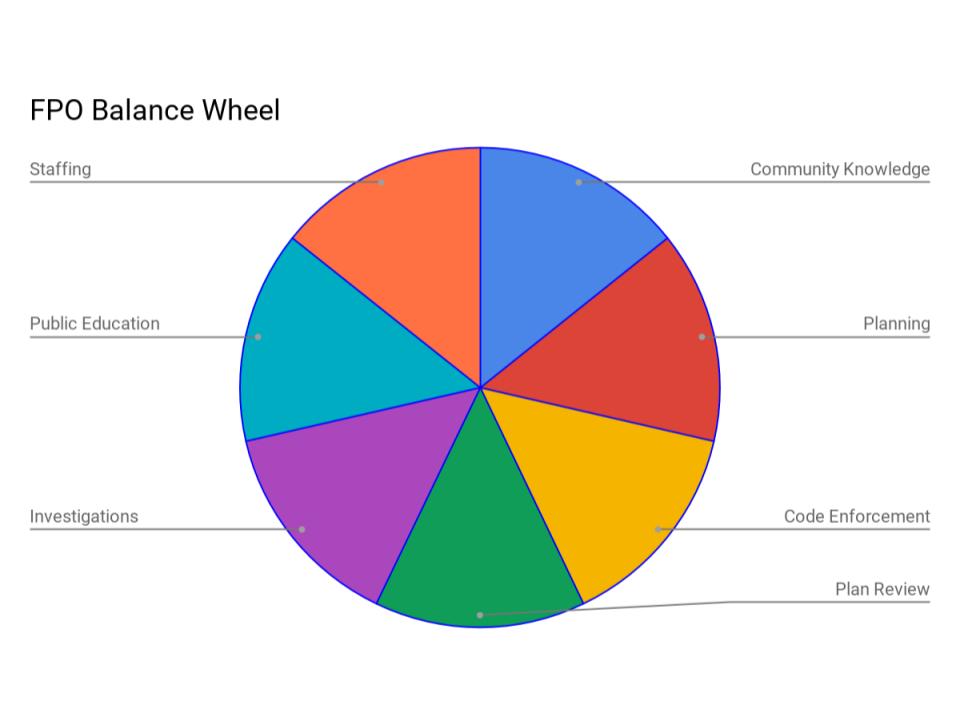
In my latest book, Fire Prevention Blueprint, I outline seven disciplines that are required for building an effective fire prevention organization. But, how can you rate your current level of effectiveness? To answer this question we have developed the “FPO balance wheel”.

The “FPO balance wheel” addresses each of the seven disciplines required for an effective fire prevention organization. This tool will help to assess where your organization is, and what areas need to be improved on to achieve maximum effectiveness.


How to use the wheel:
  • Use the questions below as a guide to accurately rate yourself on each discipline. 
  • See the center of the circle as 1 and the outer edge as 10. (1 is the worst, 10 is the best)
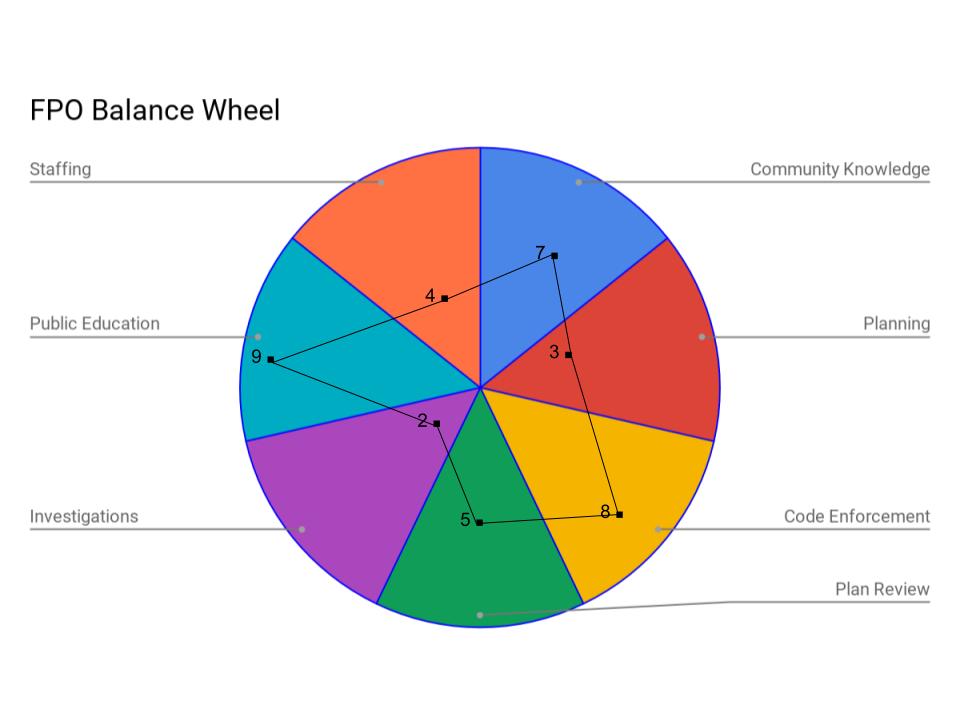
  • Rate your organization on its effectiveness in that specific discipline, by placing a dot in the numeric range. Also, write the rank number beside the dot.
  • After you have ranked each section with a dot, connect all the dots with a straight line. This new ‘shape’ is a visual representation of current balance in your organization.


Example of Completed FPO Balance Wheel


Know Your Community
  • Have you completed a CRA (community risk assessment)?
  • Do you know the seven content areas that need to be assessed for the CRA?
  • Do you know the specific risks and hazards within each area of your community?
  • Do you know where to get data from and how to use it?

Have a Plan
  • Do you have a specific and separate ‘operations manual’ for your fire prevention organization?
  • Does this manual fully outline all the tasks and responsibilities of your organization?
  • Do you have a strategic plan in place that effectively addresses the communities fire protection and life safety needs?
  • Does your fire prevention plan accurately outline the programs and strategies that will be utilized to reduce, mitigate, or eliminate risks posed to the community?
  • Is your plan or strategy made up of realistic and achievable goals?
  • Have you created a long-range plan for the success of your organization?

Enforce the Code
  • Are you currently conducting inspections in all buildings at regular intervals?
  • Have you classified the occupancy risk of each structure?
  • Do you know how many inspections are required annually, biennially, and triennially?
  • Have you pre-planned your structures so you know the risks and hazards they pose?
  • Have you established inspection frequency for all buildings?
  • Do your personnel have the ‘soft skills’ necessary for gaining compliance?

Conduct Plan Review and Field Inspections
  • Do you know the nine elements of effective plan review?
  • Do your personnel have a clear understanding of the functions and benefits of plan review?
  • Is your organization involved in the commissioning and integrated systems testing process?

Investigate Fire Incidents
  • Do you have personnel in place to conduct fire investigations?
  • Are company officers properly trained to conduct preliminary fire investigations?
  • Are you maximizing the data gathered from these investigations?
  • Are you familiar with NFPA 921 and the six-step investigation methodology?
  • Are your personnel equipped with all the necessary tools to conduct a thorough investigation?

Educate the Public
  • Are your public education programs interactive and engaging?
  • Are your public education programs relevant to community needs?
  • Have you built strategic partnerships with community stakeholders?
  • Do your public educators know how to communicate effectively?

Be Adequately Staffed

Review your balance wheel rankings for each section. After looking at your whole wheel consider the following questions for improvement.
  1. List four things that this wheel exercise tells you about your FPO.
  2. Did you rate the majority of sections as a 5 or less, or 6 or higher?
  3. How many sections are 5 or less?
  4. What areas do you want to most change or improve?
  5. What actions do you need to take to balance out your wheel or make needed changes?
  6. What resources will you need to make this happen?