Pages

Showing posts with label management. Show all posts

Managing the Fire Prevention Organization

With the many tasks, responsibilities, and requirements of the fire prevention organization how can personnel and resources be best utilized to  ensure that they are functioning at optimal effectiveness? Can they know that they are focusing on the right tasks and activities? The solution is a clear plan of action that identifies and provides for the most effective and efficient methods for performing essential fire prevention functions.

  • Identify the seven disciplines of effective and efficient fire prevention organizations.
  • Describe the key functions, features, and components of each discipline.
  • Apply practical guidance for implementation of each discipline.
  • Utilize readily available tools and resources for continued effectiveness and efficiency.


I have written extensively on this subject. Articles that delve deeper into these topics can be found at the below links.

Fire Prevention Blueprint - What it is, and how it can benefit your department.
Seven Disciplines for Effective FPO's - Identifying and defining the seven disciplines.
The FPO Effectiveness Tool -  How to use the “FPO balance wheel” to assess your organization.


Learn more at, FPOblueprint.com.

The FPO Effectiveness Tool


Listen to an audio presentation of this post.


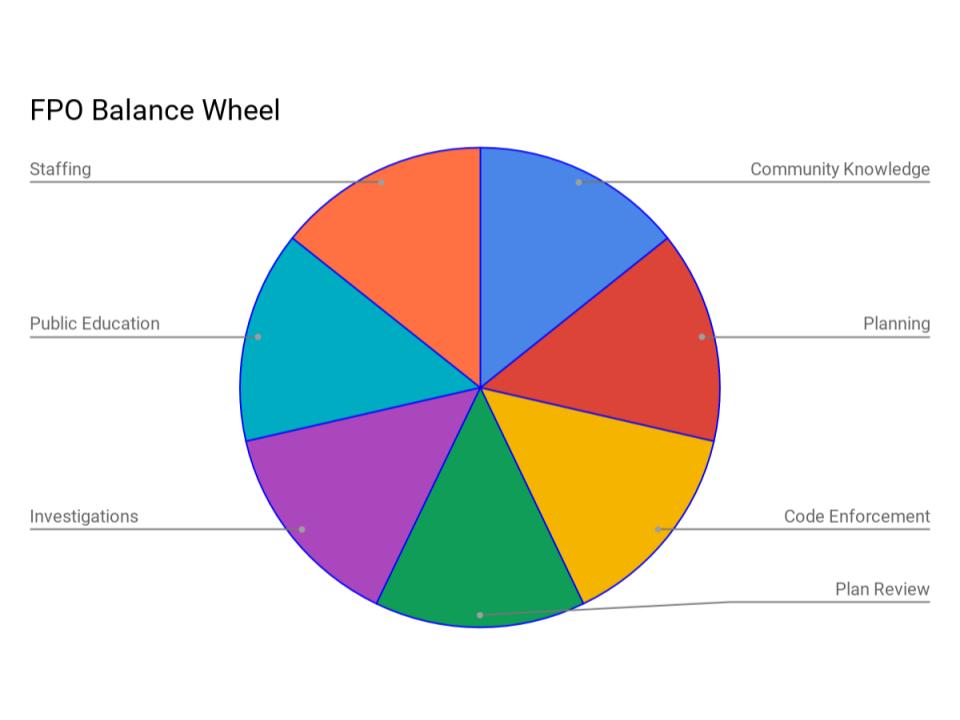
In my latest book, Fire Prevention Blueprint, I outline seven disciplines that are required for building an effective fire prevention organization. But, how can you rate your current level of effectiveness? To answer this question we have developed the “FPO balance wheel”.

The “FPO balance wheel” addresses each of the seven disciplines required for an effective fire prevention organization. This tool will help to assess where your organization is, and what areas need to be improved on to achieve maximum effectiveness.


How to use the wheel:
  • Use the questions below as a guide to accurately rate yourself on each discipline. 
  • See the center of the circle as 1 and the outer edge as 10. (1 is the worst, 10 is the best)
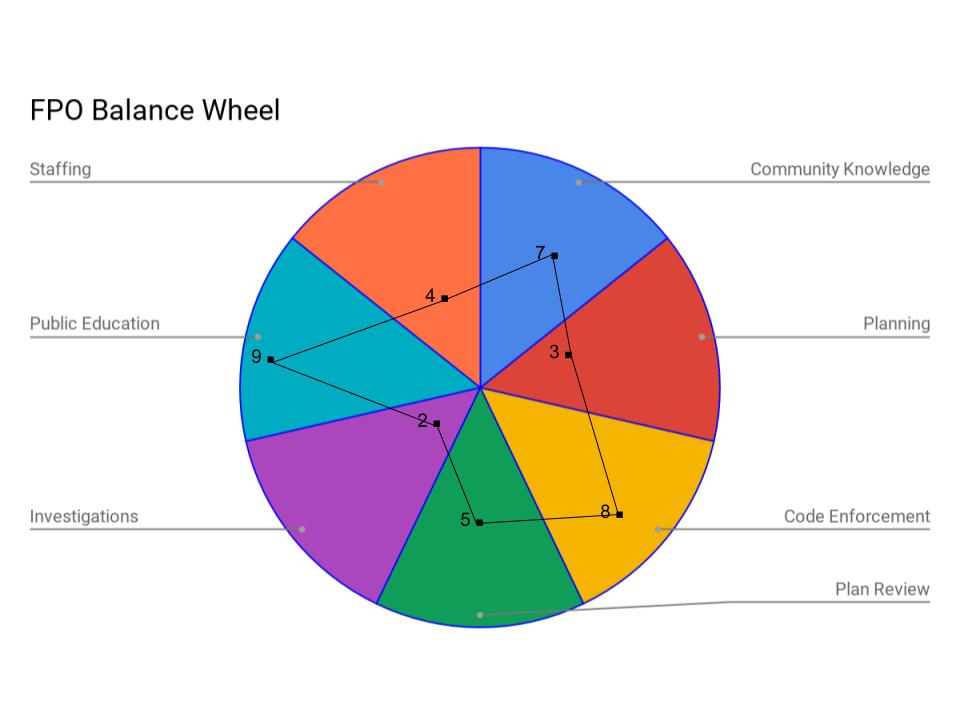
  • Rate your organization on its effectiveness in that specific discipline, by placing a dot in the numeric range. Also, write the rank number beside the dot.
  • After you have ranked each section with a dot, connect all the dots with a straight line. This new ‘shape’ is a visual representation of current balance in your organization.


Example of Completed FPO Balance Wheel


Know Your Community
  • Have you completed a CRA (community risk assessment)?
  • Do you know the seven content areas that need to be assessed for the CRA?
  • Do you know the specific risks and hazards within each area of your community?
  • Do you know where to get data from and how to use it?

Have a Plan
  • Do you have a specific and separate ‘operations manual’ for your fire prevention organization?
  • Does this manual fully outline all the tasks and responsibilities of your organization?
  • Do you have a strategic plan in place that effectively addresses the communities fire protection and life safety needs?
  • Does your fire prevention plan accurately outline the programs and strategies that will be utilized to reduce, mitigate, or eliminate risks posed to the community?
  • Is your plan or strategy made up of realistic and achievable goals?
  • Have you created a long-range plan for the success of your organization?

Enforce the Code
  • Are you currently conducting inspections in all buildings at regular intervals?
  • Have you classified the occupancy risk of each structure?
  • Do you know how many inspections are required annually, biennially, and triennially?
  • Have you pre-planned your structures so you know the risks and hazards they pose?
  • Have you established inspection frequency for all buildings?
  • Do your personnel have the ‘soft skills’ necessary for gaining compliance?

Conduct Plan Review and Field Inspections
  • Do you know the nine elements of effective plan review?
  • Do your personnel have a clear understanding of the functions and benefits of plan review?
  • Is your organization involved in the commissioning and integrated systems testing process?

Investigate Fire Incidents
  • Do you have personnel in place to conduct fire investigations?
  • Are company officers properly trained to conduct preliminary fire investigations?
  • Are you maximizing the data gathered from these investigations?
  • Are you familiar with NFPA 921 and the six-step investigation methodology?
  • Are your personnel equipped with all the necessary tools to conduct a thorough investigation?

Educate the Public
  • Are your public education programs interactive and engaging?
  • Are your public education programs relevant to community needs?
  • Have you built strategic partnerships with community stakeholders?
  • Do your public educators know how to communicate effectively?

Be Adequately Staffed

Review your balance wheel rankings for each section. After looking at your whole wheel consider the following questions for improvement.
  1. List four things that this wheel exercise tells you about your FPO.
  2. Did you rate the majority of sections as a 5 or less, or 6 or higher?
  3. How many sections are 5 or less?
  4. What areas do you want to most change or improve?
  5. What actions do you need to take to balance out your wheel or make needed changes?
  6. What resources will you need to make this happen?


Seven Disciplines for Effective FPO's


The two biggest challenges faced by fire departments and fire prevention organizations around the country are budgets and personnel, specifically, having enough funds and personnel to provide essential fire prevention services.
How can a community build a functioning fire prevention organization? How can the organization prove its value? What programs and features should be offered? Where are the organization’s best efforts and dollars spent? How can the fire prevention organization, programs, staffing and budget be justified? The seven disciplines presented in the Fire Prevention Blueprint will address these challenges and can serve as a manual for the establishing, organizing and managing the fire prevention functions of a fire department.
But, the key to success in these situations, as in any emergency situation, is to have a plan of action, and just start working the plan. This book is that plan!
Whether you are taking over a fire prevention organization, you are creating a brand new organization, or if your existing organization needs to be restructured, the Fire Prevention Blueprint is your guide. Based on historical context, current needs, best practices, published standards, and successful fire prevention programs, this guide presents the seven disciplines that must be in place for fire prevention organization success. Following these disciplines will lead to an effective and efficient fire prevention organization.
Discipline can be defined as, "an organization’s responsibility to provide the direction needed to satisfy the goals and objectives it has identified." These seven disciplines are structured to start with identification and creation of the organization’s goals and objectives, and then the practical implementation to accomplish those objectives.
The seven disciplines outlined in the Fire Prevention Blueprint, are:
Discipline #1: Know the community.
Discipline #2: Have a plan.
Discipline #3: Enforce the code.
Discipline #4: Conduct plan review and field inspections.
Discipline #5: Investigate fire incidents.
Discipline #6: Educate the public.
Discipline #7: Be adequately staffed.
The object of this guide is to provide the framework and basic blueprint. The Fire Prevention Blueprint will empower you to:
    • Identify essential fire prevention and life safety functions
    • Understand how to utilize effective systems and processes
    • Create a plan of action for building or restructuring a fire prevention organization

Kindle - $1.99
Print - $6.99

Fire Prevention Blueprint

Attention, Fire Prevention Professionals!


Build an Effective and Efficient Fire Prevention Organization!


Create an effective fire prevention organization by:
  • Identifying essential fire prevention and life safety functions
  • Understanding how to utilize effective systems and processes
  • Creating a plan of action for building or restructuring a fire prevention organization
Are you a fire protection professional - inspector, engineer, safety director, fire marshal, or AHJ - that is faced with the challenge of doing more with less? Are you tired of being reactive instead of proactive in your prevention efforts? Do you feel overwhelmed by the tasks that can never seem to get accomplished? Do you wonder if your team is focusing on the right functions and activities? Is your vision for your department unfulfilled? You need a clear plan of action. This is your action plan!


Identify the seven disciplines for effectiveness and efficiency.
    Based on historical context, current needs, best practices, published standards, and successful fire prevention programs, the Fire Prevention Blueprint identifies seven disciplines critical to the effectiveness of any fire prevention organization.
  1. Know your community.
  2. Have a plan.
  3. Enforce the code.
  4. Conduct plan review and field inspections.
  5. Investigate fire incidents.
  6. Educate the public.
  7. Be adequately staffed.
Describe the key functions, features, and components of these disciplines.
    The Fire Prevention Blueprint  addresses the most important questions and highlights the major features of these seven disciplines.
  • What are the key elements you must know and understand about your community?. 
  • What is a strategy? How can you create one for your community and fire prevention organization?
  • How often should you be inspecting the various structures within your community?
  • Do you have a clear understanding of  the functions and benefits of plan review? Are you fully aware of your role on the building commissioning team?
  • Do you know how to maximize the data gathered from origin and cause investigations?
  • Are you providing the most needed, in-demand, and valuable public education programs? 
  • Why do people want to work for your organization? How can you attract them? How can you keep them?
Apply practical guidance to implement each discipline. 
    Application of the Fire Prevention Blueprint will enable you to effectively establish, organize, and manage, the fire prevention functions of your organization.  You will be empowered to implement these seven disciplines by:
  • Understanding where to get data from, and how to use it.
  • Learning how to structure a fire protection and life safety strategy for your community, and form a long-range plan for your fire prevention organization.
  • Properly categorizing facility inspections based on hazard risk, operations, and construction features.
  • Building an integrated testing plan.
  • Following a simple 6-step process for fire scene investigation.
  • Knowing the 10-step process for selecting public education programs
  • Learning the basic skills for public speaking and teaching.
  • Applying Peter Drucker’s 3-step process for time management to your fire prevention organization.
  • Following the NFPA recommended 5-step process to determine and justify staffing needs.

Utilize multiple tools, resources, and references for further study and application.
    The goal of  Fire Prevention Blueprint is to provide a basic framework on which to build your organization.  There is an abundance of resources available on each of these seven disciplines and their subtopics. The best tools and resources are referenced in this guide:
  • Via footnotes in the text.
  • A bonus annex section. 
  • A website with direct links to all referenced tools and documents. 
It has taken me more than a decade in this industry to clarify this system for fire prevention organization operation. When I sat down to write this book, I simply wrote down the information I wish I would have had over ten years ago, when I started out on this fire prevention quest!


Kindle - $1.99
Print - $6.99


Still not sure if this is right for you? Learn more and subscribe to the mailing list at, www.FPOblueprint.com


How to Build an Effective Fire Prevention Organization


The fire service is an organization that has become known for doing more with less. Less tools, less equipment, less personnel, and less money. Many fire prevention organizations have too few dedicated fire prevention personnel to cover the many square feet of space or miles of geography within their communities. Fire prevention organizations are responsible for the tasks of life safety inspections, fire protection system inspections and testing, plan reviews, investigations, public education, and myriad administrative tasks. All this while also being expected to stay abreast of new technologies, code developments, legislative changes, and planning for the future of the fire prevention organization and its role within the community.   

This workload creates a reactive environment.  One in which fire prevention organization and personnel are functioning only to respond to the most emergent issue, “what needs to be done now”.  These organizations run the risk of being able to only accomplish the minimum required tasks, or less. These conditions can lead to critical fire protection and life safety issues that are allowed to develop until they become a major incident, which results in loss of property or worse, loss of life.

Fire protection professionals - inspectors, investigators, engineers, building safety directors,  the Fire Marshal - did not get into this field to barely get by, or to race to the bottom, or to just work to meet “minimum” standards, or “try their best”, or to do things “the way they’ve always been done”, to simply maintain the status quo. You entered the field because you had a vision to change your world or community by protecting property and saving lives from fire loss.

With the many tasks, responsibilities, and requirements of the fire prevention organization how can this vision be realized? How can the fire prevention organization and its personnel be best utilized to  ensure that they are functioning at optimal effectiveness? Can they know that they are focusing on the right tasks and activities? The solution is a clear plan of action that identifies and provides for the most effective and efficient methods for performing essential fire prevention functions.

With the right plan of action and a laser-like focus on essential tasks your vision for your community and organization can be realized. Your organization can be transformed from just getting by, doing the bare minimum, trying to stay “afloat”,  into a purpose driven, forward advancing, progress making, community changing, organization!

The Fire Prevention Blueprint is your action plan! This book reveals the seven disciplines of effective and efficient fire prevent organizations, and provides practical guidance and resources for their implementation. Fire Prevention Blueprint: Seven Disciplines for Building Effective Fire Prevention Organizations accomplishes this by identifying essential fire prevention and life safety functions, understanding how to utilize effective systems and processes, and providing the framework for creating a structured and organized plan of action.

Don’t let your community become the next mass fire casualty or large fire loss headline. Buy the Fire Prevention Blueprint and transform your fire prevention organization into your vision of what you know it can be!

For more information, resources, and to order the book, visit:

Five Systems for Effective Fire Department Management


Photo courtesy of LAFD Photo | Harry Garvin

The two standards that address the organization of fire departments and provision of firefighting services, NFPA 1710 (career) and NFPA 1720 (volunteer), outline five systems that must be in place for effective fire department management.


Safety and Health System. An occupational safety and health program must be provided. This program must meet the requirements of, and be established in accordance with, NFPA 1500.


NFPA 1500, Standard on Fire Department Occupational Safety, Health, and Wellness Program,  specifies the minimum occupational safety and health program requirements for organizations that provide fire, rescue, and emergency medical services.


Incident Management System (IMS). The incident management system is a crucial component of all fire department operations, as it provides the foundation for all operation types.


NFPA 1561, Standard on Emergency Services Incident Management System and Command Safety, defines the roles and responsibilities of command functions and describes the essential elements of an incident management system.


Training Systems. Having a training system in place ensures that all members are trained for, and competent to, execute the fire department's stated responsibilities.  Training programs should be based on the communities hazards and risks, and the minimum criteria stated in the following code sections:


Communications Systems. All emergency services organization must have a reliable communication system. These are essential for the prompt delivery of fire, rescue, and EMS services.


NFPA 1221, Standard for the Installation, Maintenance, and Use of Emergency Services Communications Systems, provides guidance and requirements for facilities, equipment, staffing, and operational procedures  for emergency communications centers.


Pre-Incident Planning. A communities structures, hazards, and risks, should be identified and potential emergencies planned for.  A priority for pre-incident planning are those facilities considered to be target hazards.


NFPA 1620, Standard for Pre-Incident Planning, should serve as a guide in developing plans that will assist in managing incidents and protecting lives and property. Elements of pre-incident planning should include,  fire protection systems, building construction type, building contents, and facility functions and operating procedures.


For successful fire department operations and the safety and security of your community these five systems must be in place. With the overwhelming amount of responsibilities, tasks, and requests that need to be addressed,  keeping these five critical systems in mind, will keep your department focused and on the path of forward progress.

Related Posts:

7 Response Objectives for Fire Departments


Fire on a rainy day, by Canadian Pacific

The purpose of NFPA 1710 is to provide minimum criteria to address “the effectiveness and efficiency of career” fire department personnel and operations.  This standard outlines seven objectives that fire departments must meet.  Stations, staffing, and systems, of the department should be organized appropriately and work together to meet these objectives.

  1. Alarm handling time.
  2. Turnout time.
  3. First unit on-scene time.
  4. Time to full alarm assignment deployment.
  5. Travel to full alarm assignment deployment at high-rise incidents.
  6. Time for AED on-scene.
  7. Time to arrival of ALS unit.

Alarm handling time. At least ninety-five percent of alarms must be answered within 15 seconds, and no more than 40 seconds for ninety-nine percent of alarms.  Alarm answering time is the length of time from the alarm being received at the communications center to the time that it is acknowledged.

Turnout time. Eighty seconds for fire and special operations, and sixty seconds for EMS. Turnout time is the time between  when the fire station receives an alarm and units go ‘en-route’, begin traveling to the scene.

First unit on-scene time. The first engine shall arrive at a fire scene within 4 minutes.

Time to full alarm assignment deployment. A full alarm assignment is to be deployed on the fire scene within 8 minutes.

Time to full alarm assignment at high-rise incidents.  A full alarm assignment is to be deployed on a high-rise fire scene within 10 minutes (610 seconds).

Time for AED on-scene. A first responder with AED (automatic external defibrillator) shall be on-scene at any emergency medical incident within 4 minutes.

Time to arrival of ALS unit. For departments that provide advanced life support (ALS) services, an ALS unit is to be on-scene at all emergency medical incidents within 8 minutes.


Additional Resources


Managing the Implementation Team (Part 4)

This is Part 4 of a 6 part series collectively titled, McKinsey Method for Fire Protection Solutions. As you read keep in mind that these systems and processes can be applied to  fire protection organization and leadership, and to physical fire protection systems and components.


After a problem has been analyzed and a solution has been presented and accepted, the work of implementation begins. Implementing the problem solution requires the effective management of three components:
  1. The Team.
  2. The Client.
  3. The Individual.

The Team.
These are the people that you will be working together with to implement the problem solution. The manager has three responsibilities related to the team, he must assemble the right team members, he must keep them motivated to complete the task, and he must ensure their continued professional development.

Effective team management starts with recruiting, or assembling, the right people. To acquire the best talent for the team, the manager should start with a structured plan.  The plan should let the manager easily see what type of personality would fit best, what types of skills are needed, and what specific knowledge may be required. Using the plan, the manager can select those individuals that bring the strengths necessary to the project.  A team that is has all the same strengths and weaknesses will fail.  When assembling the team, maintaining the right mix or knowledge, skills, and abilities is critical.

McKinsey keeps its people motivated by spending time together and providing adequate rewards.  Motivation can be maintained by creating a familiar atmosphere to work in.  Create a workplace that people want to come to, a place where they feel like they contribute and are a part of something bigger.  Planned team events, bonding outings, can be effective also. The most effective of these are the more “impromptu” events that are put together by someone other than the “boss” or manager.  Provide rewards, above and beyond compensation, for the team members.  Rewards can include things like dinners and lunches paid for by the organization, and additional days, weekends, or time off. When the team members feel that the organization has taken notice of their work, appreciates their contribution, and acknowledges the existence of their personal and family life, they will be motivated to continue giving their best to the solution implementation team.

Team members want the organization to contribute to their professional development.  The effective team manager can accomplish this by setting clear expectations and providing regular and consistent evaluations. Clarity of expectations ensures that all the team members know what they are working for and how their work product and performance will be evaluated. This allows them to focus on areas of their profession that should be developed in order to meet and exceed the expectation.  Regular and consistent evaluations by the manager, let the team member know that he is on the right track, and his performance is meeting the expectation. At least, six month, evaluations are recommended.  This allows the manager to see what the employee has accomplished so far, and what professional goals and development benchmarks have been set for the next six months.

The Client.
This is who you work for. In the private sector this is the company or organization that is paying for the services. In the public sector, this is the community, municipality, and stakeholders.

Effective management of the client requires that they be informed, involved, and inspired. Communication is key. The client should always be “in the loop” and never be surprised by any changes or developments in the planned solution. The client wants to feel like they are involved and contributing to this project.  Let them be involved. Invite them to the meetings, assign them tasks that need to be done that they can do.  Utilize them as part of your team.  They need to stay inspired. The manager must continue to sell the solution throughout its implementation, so that the client stays focused on their desired outcome and keeps the big picture at the forefront of his mind.

The Individual.
Yourself. Individuals have a hard time providing a good work product when they are out of balance with their personal life. The manager cannot effectively manage the team, if his personal life feels like it is being mismanaged.

Often individuals search for work/life balance, however, the true ‘sweet spot’ is in the seamless integration and intertwining of work and life. A situation where the two exist and flow together. This work/life flow can be achieved through mentors, supporting one another, sharing the load, and effective time management. Maintaining work/life flow and avoiding “burn out” requires the individual to stay focused on the purpose, vision, and goals of the task at hand.